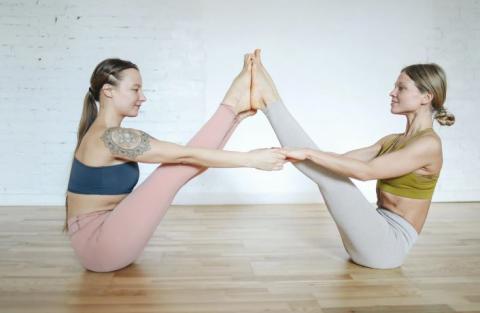
Stress and anxiety were once considered only to be mental health conditions. But in fact, they affect us physically, especially when we experience them for long periods of time. They can lead not only to a diminished sense of well-being and happiness but also to debilitating and costly health conditions.
A recent study examined the effectiveness of using yoga to reduce anxiety, which many people label as “stress.” The study findings suggest that yoga is more effective than educating a person on standard ways to manage stress. As a Registered Yoga Teacher (and a licensed mental health professional), I believe that the findings are likely due to yoga’s experiential nature; individuals can engage in the practice as opposed to intellectually addressing their anxiety and stress. Today I’ll bring my perspective as both a licensed mental health professional and a certified yoga instructor to discuss this mind-body pathway to greater well-being.
Demystifying Yoga
Mystery can be an appealing characteristic of some products or concepts. But it can also be a barrier to access. Let’s demystify yoga a bit. First, let me tell you a little about yoga.
Yoga originated in India roughly 5 millennia ago. So, it pre-dates modern mental health therapies by a little – about 4,900 years! In the late 1800s and early 1900s, yoga masters in India decided to share the practice with the West after recognizing its incredible physical, mental, and spiritual impact on people in Asia. As the years passed, yoga continued to grow in popularity among Westerners. According to the Yoga Alliance, which is the accreditation board for yoga teachers like me, there are over 36 million yoga practitioners in the US. That’s over 10% of the population, and it's growing rapidly.
Remarkably, 86% of ‘yogis’ reported that yoga provided them with a strong sense of mental clarity, but interestingly the number 1 reason for starting yoga was to improve physical ability. I find this to be true with the people I teach; most come for physical reasons but keep coming due to the mental and emotional benefits.
Misconceptions
There are a ton of misconceptions I hear from people who are considering taking up yoga or trying a yoga class. When someone says the word ‘yoga,’ many people have an image of a person sitting cross-legged with their eyes closed, saying, “Ohm.” Others might picture a person on their head or balance on one leg. These are all stereotypes. With these misconceptions come excuses, something we humans excel at. “I’m not flexible enough.” “I’m too old.” “I don’t have the time.” “I don’t have a mat, clothes, or space.” “I can’t meditate.” The list goes on. I want people to realize that everyone can do yoga regardless of age, body size, ability, gender, race, or religion. There are no prerequisites, and you don’t need a special mat or fancy yoga clothes to reap the benefits.
A union of body and mind to reduce anxiety and stress
So what exactly is yoga, and how does it work? The word ‘yoga’ is Sanskrit (the language of ancient India and the predominant language of most works of Hindu philosophy as well as some of the principal texts of Buddhism and Jainism) and means ‘union.’ We are essentially creating a union between the body and mind.
Yoga is the discipline of strengthening the focus of the mind, which allows us to gain more control over our body and senses. Once one can obtain concentration and control over mind and body, true meditation can be obtained. When we can regularly strengthen our control over mind and body through yoga movements and then meditation, we see incredible benefits that positively improve daily functioning. Benefits of regular practice include but are not limited to greater flexibility and range of motion, reduced pain and soreness, reduced fatigue, increased muscle strength and tone, improved respiration and energy, weight reduction, improvement in other athletic performance, improved circulatory health, improvement of posture, boost in immunity, prevents digestive problems, and reduces blood pressure. The practice improves sleep, mood, and mental focus and increases self-esteem. One will notice they are less reactive because they are living in a more mindful way. I don't know what will if that’s not enough to get you on a mat!
Breathing and mindful movement
The key to making yoga effective in reducing anxiety is the connection between breathing and mindful movement. The quickest way to reduce anxiety in a given moment is through the use of proper breathing. Many people are either holding their breath unconsciously or taking very shallow breaths. Both are recipes for increased anxiety and even panic.
Aside from encouraging proper breathing, yoga is a way to bring awareness to the signals in our body that we might otherwise be ignored on a day-to-day basis due to the business of life. When we combine movement and breathing, the central nervous system calms down, and our stress level drops. For those with diagnosed anxiety conditions, yoga may be combined with talk therapy so individuals can experience the benefits of recognizing and changing thought patterns that contribute to the cycle of anxiety while also making physical changes that further support those mental changes.
I hope you will explore yoga further, personally or for your workplace. Get your yoga on and start benefiting mentally and physically.